



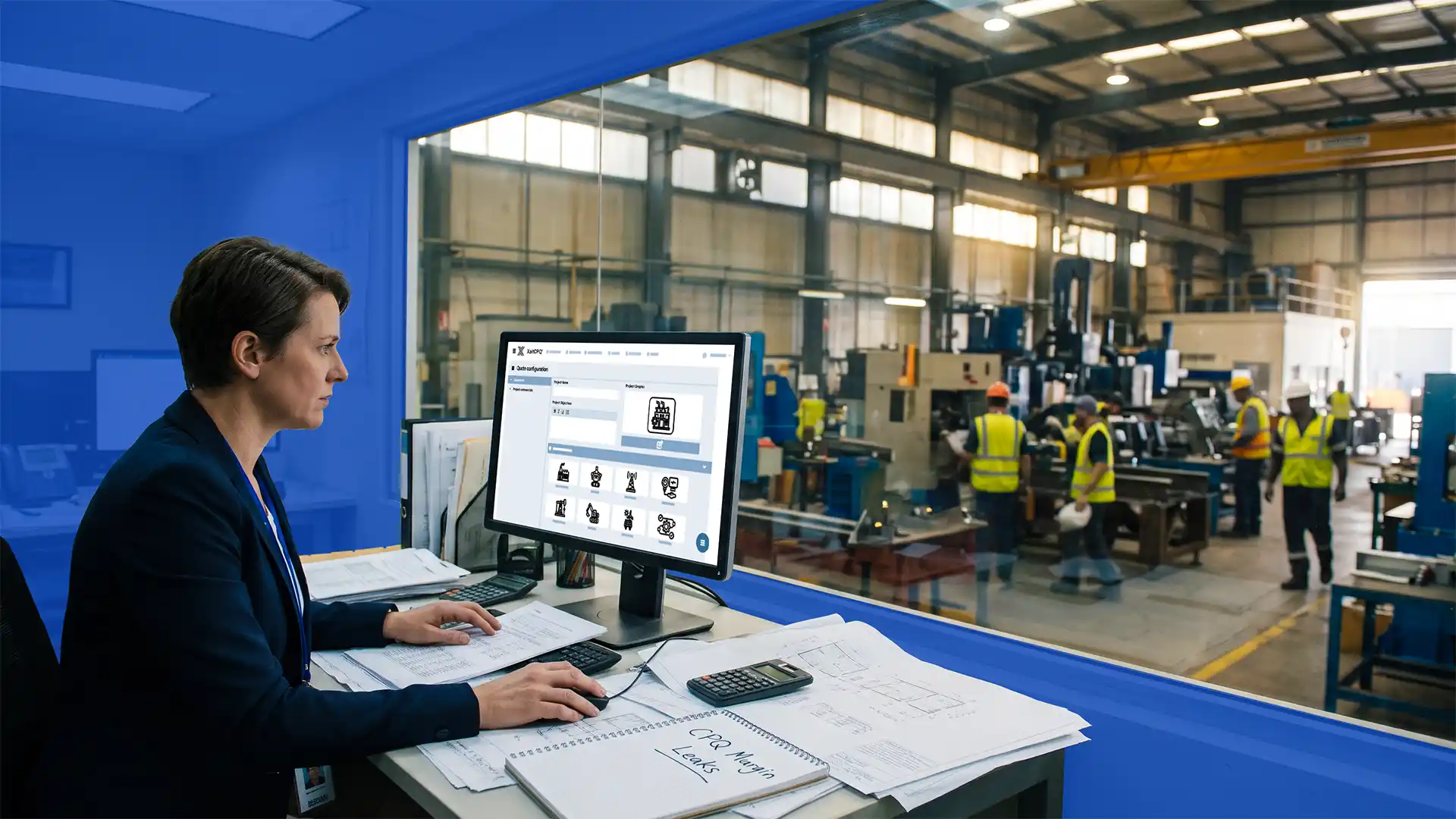
Is your quoting process quietly draining profit before a single product leaves the factory floor? For manufacturers and engineering firms quoting complex, configured products, margin loss rarely starts on the production line. It starts in the quote itself, buried inside pricing rules, approval bottlenecks, and disconnected systems that nobody audits until the damage is done.
This guide breaks down the root causes behind CPQ implementation failures that drive quote inaccuracy and margin erosion. You will find practical frameworks for diagnosing where your quoting workflow breaks down, which process controls to tighten, and how to design a CPQ system that protects margins at every step from configuration to contract.
Whether you manage a sales operations team, run proposals for engineered-to-order equipment, or oversee pricing governance across multiple product lines, this is your reference for turning a leaking quoting process into a competitive advantage.
Key Takeaways: CPQ Margin Leaks in Manufacturing
- Margin leakage in manufacturing typically originates in the quoting process, not on the production floor.
- Disconnected CRM, ERP, and CPQ systems create pricing conflicts that erode profitability on every quote.
- Poorly defined configuration rules lead to unbuildable quotes, rework, and uncontrolled discounting.
- XaitCPQ helps manufacturers govern pricing, automate approvals, and reduce quoting time by up to 50%.
- Structured implementation with phased rollouts and cross-functional alignment prevents costly CPQ failures.
What Is a CPQ Margin Leak?
A CPQ margin leak is any gap in your configure-price-quote workflow that allows profit to slip away between the initial quote and the final contract. These gaps are rarely visible in a single transaction. They accumulate across hundreds or thousands of quotes, compounding into significant revenue loss over a fiscal year.
Common forms include incorrect discount application, outdated cost data feeding into pricing calculations, configuration choices that trigger unplanned engineering work, and stalled approvals that force sales teams to offer last-minute concessions. According to an RSM Technology analysis (2026), margin leakage frequently begins long before a product is manufactured, starting when pricing information is spread across spreadsheets and multiple disconnected systems.
The challenge for manufacturing sales leaders is that these leaks do not trigger alarms. They hide inside processes that appear to work, until a quarterly margin review reveals the gap between quoted and delivered profitability.
Why Do CPQ Implementations Fail in Manufacturing?
CPQ projects in manufacturing fail more often than they succeed, and the reasons are rarely technical. They are organizational. Teams underestimate the data preparation required, skip cross-functional alignment, and attempt to solve every quoting problem in a single phase.
Industry research consistently identifies the same barriers: integration challenges with ERP and CRM systems, overly complex product configurations that exceed the platform's rule capacity, difficulty proving ROI to secure budget, and internal resistance to changing established workflows. When 43% of manufacturers still rely on spreadsheets for quoting and report satisfaction with those tools despite documented inaccuracy, complacency becomes the primary obstacle.
The result is a CPQ deployment that sales teams do not trust, engineering teams refuse to validate, and finance cannot reconcile with actual costs. Each of these breakdowns feeds directly into margin leakage.
How Do Disconnected Systems Cause Margin Loss?
When your CPQ, CRM, and ERP operate as separate systems with no real-time data exchange, every quote carries a risk of pricing conflict. Sales representatives must switch between tools to gather data, import information manually, and rely on spreadsheets to bridge gaps between platforms. Each handoff introduces the possibility of outdated pricing, incorrect product availability, or misapplied discount structures.
The downstream impact is measurable. When product details change and the update does not propagate across systems, quotes go out with discontinued features, incorrect material costs, or obsolete compliance requirements. Your customer receives a quote that looks accurate on paper, but the margin baked into that quote no longer reflects the real cost of fulfillment.
Solving this requires more than a middleware connector. It requires a CPQ architecture that treats CRM and ERP integration as a foundational design principle, not an afterthought bolted on during Phase 3 of a rollout.
What Role Do Configuration Rules Play in Quote Accuracy?
Configuration rules are the logic engine behind every CPQ quote. They determine which product combinations are valid, which components require engineering review, and which pricing tiers apply based on volume, region, or contract terms. When these rules are incomplete, outdated, or poorly structured, every quote downstream carries embedded risk.
In manufacturing, configuration complexity far exceeds what standard CPQ platforms were designed to handle. Products with thousands of variants, interdependent options, and engineering tolerances require rules that go beyond simple yes-or-no logic.
When teams attempt to force-fit these requirements into a rigid rule engine, they create what industry practitioners call a "custom build disaster." Configuration complexity drives up both implementation cost and ongoing maintenance burden.
The fix starts with documenting tribal knowledge, the unwritten rules that veteran engineers carry in their heads and apply instinctively during manual quoting. Until that knowledge is formalized, codified, and validated, no CPQ system can produce consistently accurate quotes.
How Does Pricing Governance Prevent Margin Erosion?
Pricing governance is the set of controls that dictate who can discount, by how much, under what conditions, and with whose approval. Without it, your sales organization operates with inconsistent pricing practices that erode margin one deal at a time.
Consider what happens when discount approvals flow through email chains instead of automated workflows. A regional sales manager approves a 12% discount for a strategic account, but no centralized record exists. A month later, a different rep offers 15% to a smaller account, citing the precedent. Over a quarter, your average discount creeps upward without any deliberate pricing decision ever being made.
Effective pricing governance within a CPQ system automates approval routing based on predefined thresholds, logs every pricing exception, and provides real-time visibility into discount trends across the sales organization. XaitCPQ addresses this with a rules and calculation engine that governs discounts, rebates, margins, compliance, and risk automatically, removing the manual judgment calls that introduce variability into your pricing.
What Are the Most Common CPQ Implementation Mistakes?
CPQ implementations derail when teams treat the project as a software installation rather than a business transformation. Here are the patterns that consistently lead to failure:
- Scope creep: Attempting to configure every product line, region, and sales channel in Phase 1 instead of starting with a focused minimum viable product.
- Dirty data: Launching without cleaning and structuring product, pricing, and customer data. Inaccurate inputs produce inaccurate quotes regardless of how well the CPQ platform is configured.
- Siloed ownership: Treating CPQ as an IT project rather than a cross-functional initiative involving sales, engineering, finance, and operations from Day 1.
- Insufficient training: Rolling out the tool without role-specific enablement. Sales teams need guided selling workflows. Engineering teams need configuration validation. Finance teams need margin reporting.
- Ignoring change management: Underestimating resistance from teams comfortable with their existing processes, even when those processes are demonstrably broken.
Avoiding these mistakes requires executive sponsorship, clearly defined KPIs, and a phased rollout plan that delivers measurable wins early enough to sustain organizational momentum.
How to Diagnose Margin Leaks in Your Quoting Process
Diagnosing margin leaks starts with auditing the gap between quoted margin and delivered margin across a representative sample of closed deals. If the variance exceeds 2-3%, your quoting process has structural problems worth investigating.
Start by mapping every handoff in your quote-to-order workflow. Where does data move between systems? Where does a human make a manual entry or override? Each of those touchpoints is a potential leak. Then examine your discount approval records. How many pricing exceptions were granted last quarter? What percentage deviated from standard terms?
Next, review your configuration validation process. How many quotes required engineering rework after submission? How many orders came back from production with a flag for unbuildable specifications? Each rework cycle adds cost that was never reflected in the original quote.
This audit gives you a quantified baseline, the starting point for building a business case to invest in process improvement, system integration, or a dedicated CPQ platform.
How to Structure a CPQ Implementation That Protects Margins
A margin-protective CPQ implementation follows four phases: strategic alignment, enablement, scaled adoption, and continuous optimization. Skipping or compressing any phase increases the risk of the implementation mistakes described above.
Phase 1: Align Strategy, Stakeholders, and Scope
Define the specific problems CPQ must solve for your organization. Is the priority reducing quoting time, improving quote accuracy, enabling guided selling for less experienced reps, or all three? Hold cross-functional workshops to align goals across sales, engineering, IT, and finance. Define KPIs before selecting a platform.
Scope the first phase tightly. Target one product line, one geography, or one sales channel. This creates a controlled environment for validating the tool, refining your approach, and generating early ROI that justifies broader investment.
Phase 2: Prepare Data, Rules, and Enablement
Clean and structure your product, pricing, and customer data before configuring the CPQ platform. Document tribal knowledge from veteran engineers and sales managers. Design guided selling flows that simplify complex quoting for front-line teams without sacrificing configuration accuracy.
Set up a controlled test environment using real quoting scenarios. Involve end users in testing early. Their feedback during this phase is the most cost-effective quality assurance you can get.
Phase 3: Drive Adoption Through Phased Rollout
Pilot the CPQ solution with a single product line or sales region. Target role-specific training: sales teams focus on configuration and pricing workflows, while engineering users validate product logic and exception handling. Gather feedback through testing sessions, support logs, and direct input from pilot users.
Treat the rollout as an internal product launch. Share early success metrics, communicate tangible benefits, and identify pilot users who can serve as internal advocates for the broader organization.
Phase 4: Optimize Continuously
CPQ is not a one-time deployment. Products change, pricing strategies evolve, and sales channels expand. Establish a governance framework for updating product logic, rules, and integrations. Track your defined KPIs rigorously. Build internal capability so your team can manage day-to-day maintenance without depending on external consultants.
How Does XaitCPQ Address Manufacturing Margin Challenges?
XaitCPQ is built for the complexity that causes most CPQ implementations to fail. Its rules and calculation engine handles products with thousands of possible configurations, governing discounts, rebates, margins, and compliance automatically. This means your pricing governance is enforced at the system level, not left to individual judgment.
For manufacturing teams, XaitCPQ provides guided selling that walks sales representatives through valid product and service combinations, preventing configuration choices that would result in unbuildable quotes or unplanned engineering rework. The platform integrates with CRM and ERP systems, ensuring that every quote reflects current costs, inventory, and contract terms.
Manufacturers using XaitCPQ report reducing their time to quote by up to 50% and increasing profitability by up to 30%. These results come from eliminating the manual steps, disconnected data, and uncontrolled discounting that cause margin leaks in the first place.
What Controls Should You Build Into Your CPQ Workflow?
Margin protection requires specific controls embedded at each stage of the quoting workflow. Here are the non-negotiable elements:
- Automated discount thresholds: Set maximum discount percentages by product category, customer tier, and deal size. Route any exception through a defined approval chain with audit logging.
- Real-time cost integration: Connect your CPQ to live material and labor cost data from your ERP so that quotes always reflect current production economics.
- Configuration validation: Build rules that prevent unbuildable or non-compliant product combinations from reaching the quote stage. Every configuration that bypasses engineering review is a margin risk.
- Margin floor enforcement: Define minimum acceptable margins by product line and customer segment. The CPQ should flag or block any quote that falls below the threshold.
- Version control and audit trails: Maintain a complete history of every quote revision, pricing override, and approval decision. This record is essential for post-deal margin analysis.
These controls do not slow down your sales process when they are built into the CPQ platform's workflow engine. They accelerate it by removing the back-and-forth approvals that slow down quotes when governance is handled manually.
How to Measure the ROI of Fixing CPQ Margin Leaks
Quantifying the return on fixing margin leaks requires tracking three categories of improvement: direct margin recovery, process efficiency gains, and revenue velocity.
Direct margin recovery is the difference between your current average quoted margin and the margin you achieve after implementing pricing governance and configuration controls. According to the Aleran 2025 Built to Sell Report, manual quoting processes cost manufacturers an average of 5% of annual revenue in leakage and lost deals.
Process efficiency gains come from reduced quoting cycle time, fewer engineering rework requests, and lower administrative overhead. When your sales team spends less time building quotes and more time selling, pipeline velocity increases.
Revenue velocity measures how quickly a quote converts to a signed contract. Faster, more accurate quotes reduce the window in which a buyer can seek competing proposals, stall internally, or renegotiate terms. Combined, these three metrics give you a comprehensive view of CPQ ROI that extends well beyond the sticker price of the software platform.
In Conclusion: How to Stop Margin Leaks Before They Compound
Margin leaks in manufacturing CPQ are not dramatic failures. They are quiet, incremental losses that accumulate across every quote your team produces. The root causes are consistent: disconnected systems, undocumented configuration logic, inconsistent pricing governance, and CPQ implementations that treat technology as a substitute for process discipline.
Fixing them requires a structured approach. Audit your current quoting workflow, quantify the gap between quoted and delivered margins, and build a phased implementation plan that prioritizes data quality, cross-functional alignment, and measurable KPIs.
Tools like XaitCPQ give you the rules engine and guided selling framework to enforce pricing governance at scale. The tool only delivers value when it sits on top of well-defined processes and clean data.
Start with one product line, prove the margin improvement, and expand from there. Every quarter you wait is another quarter of compounding revenue loss.
FAQs About CPQ Margin Leaks in Manufacturing
What is the biggest cause of margin leaks in manufacturing CPQ?
Disconnected systems are the most common driver. When your CPQ, CRM, and ERP do not share real-time data, quotes go out with outdated costs, incorrect discount structures, or non-current product configurations. Each of these misalignments directly reduces the margin on that deal.
How can manufacturers detect margin leaks in their quoting process?
Compare your quoted margin to your delivered margin across a sample of closed deals. A variance above 2-3% signals structural issues in your quoting workflow. Map every data handoff and manual override in your quote-to-order process to identify where inaccuracy enters.
How does XaitCPQ prevent pricing inaccuracies?
XaitCPQ enforces pricing governance through automated rules that control discounts, rebates, and margin thresholds. Its calculation engine integrates with CRM and ERP systems to pull real-time cost and product data, so every quote reflects current information rather than stale spreadsheet figures.
What is a phased CPQ implementation approach?
A phased approach divides the CPQ rollout into stages: strategic alignment, data preparation and enablement, piloted adoption, and continuous optimization. Each phase builds on the previous one, reducing risk and generating measurable results before expanding scope.
Why do CPQ implementations fail in manufacturing environments?
Most failures trace back to organizational issues rather than technology limitations. Scope creep, dirty product data, siloed project ownership, insufficient user training, and underestimated change management are the recurring patterns. XaitCPQ addresses the technology side with a flexible rules engine built for manufacturing complexity, but success requires disciplined process work alongside the platform.
How does guided selling reduce quoting risk?
Guided selling uses rule-based workflows to walk sales representatives through valid product configurations step by step. This prevents representatives from selecting incompatible components, applying incorrect pricing tiers, or skipping required approvals. XaitCPQ builds guided selling directly into its quoting interface, reducing configuration-related rework.


