

-1.svg)






In today's fast-paced market, delivering accurate and customized quotes is essential for closing deals. But if your sales team is still using manual quoting methods, you're losing time and frustrating customers. Reps often struggle with complex product configurations, pricing errors, and long approval cycles, all of which extend the sales cycle.
Summary
-
What it is: CPQ stands for Configure, Price, Quote — software that helps teams select a valid product combination, price it correctly, and produce a professional quote in minutes instead of days.
-
Why it matters: When products and services depend on each other, spreadsheets break. CPQ encodes your product rules and pricing logic so every quote is buildable, priced right, and margin-safe.
-
Who it's for: Not just salespeople. Bid teams, proposal managers, engineers, and finance all feel the difference when quoting stops being guesswork.
What is CPQ?
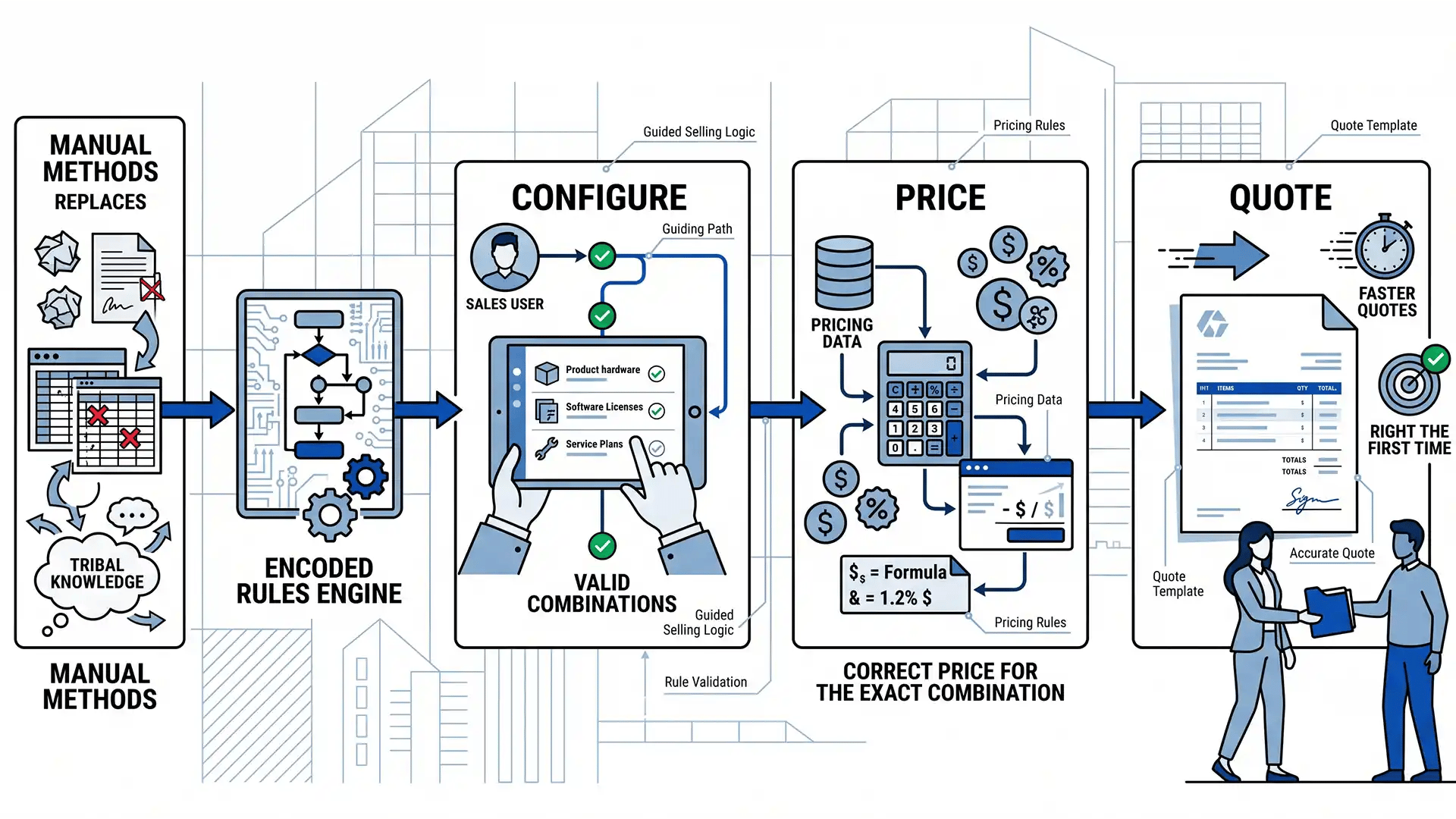
CPQ stands for Configure, Price, Quote: software that guides a team through selecting a valid combination of products and services (configure), calculating the correct price for that exact combination (price), and generating an accurate, professional quotation (quote). CPQ replaces error-prone spreadsheets and tribal knowledge with encoded product and pricing rules — so quotes go out faster, and right the first time.
If you've spent your career in bids and proposals, you may have met CPQ only in passing — a sales tool, someone else's system. But if your organization sells anything where one choice affects another (this pump needs that motor, this service level requires that hardware), CPQ is quietly determining whether the numbers in your proposal are correct. That makes it your business too.
Let's unpack the three letters, one at a time.
What does "Configure" mean in CPQ?
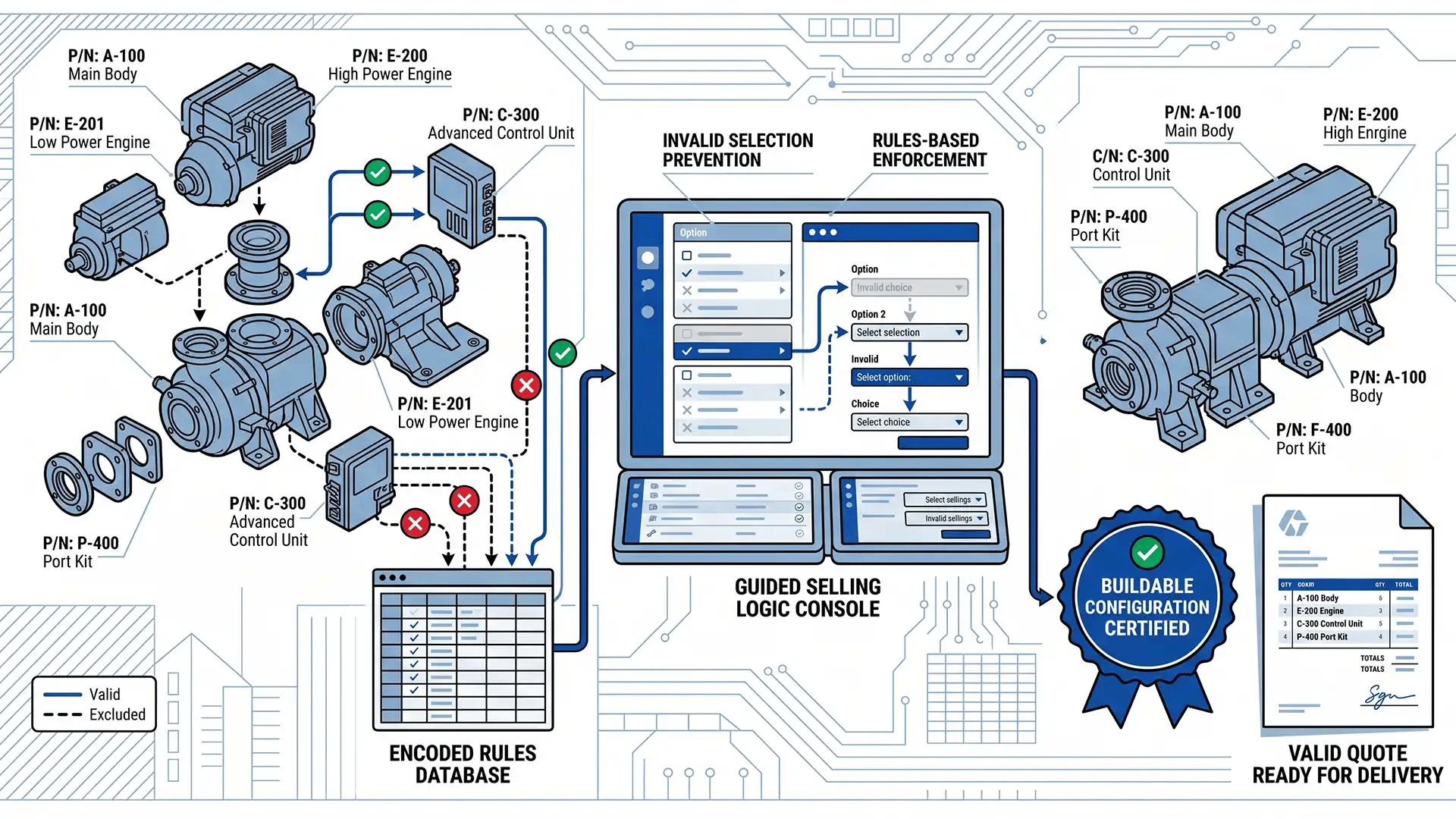
Configure means selecting a valid combination of products, options, and services from all the possible variations your company can deliver. CPQ software enforces the rules — what fits with what, what requires what, what excludes what — so it's impossible to quote a combination you can't actually build or deliver.
Think of ordering a car: engine, transmission, trim, towing package. Not every combination exists — the hybrid engine may not come with the towing package, and the sport trim may require the larger wheels. Now imagine that complexity in industrial equipment, energy services, or software licensing, with thousands of interdependent choices. In a spreadsheet, someone has to remember all those dependencies. In CPQ, the rules are encoded once, and the system only offers valid paths.
This is also where guided selling comes in: instead of expecting salespeople to know every rule, the software asks about the customer's needs and guides them to the right solution — like a GPS for product selection.
What does "Price" mean in CPQ?
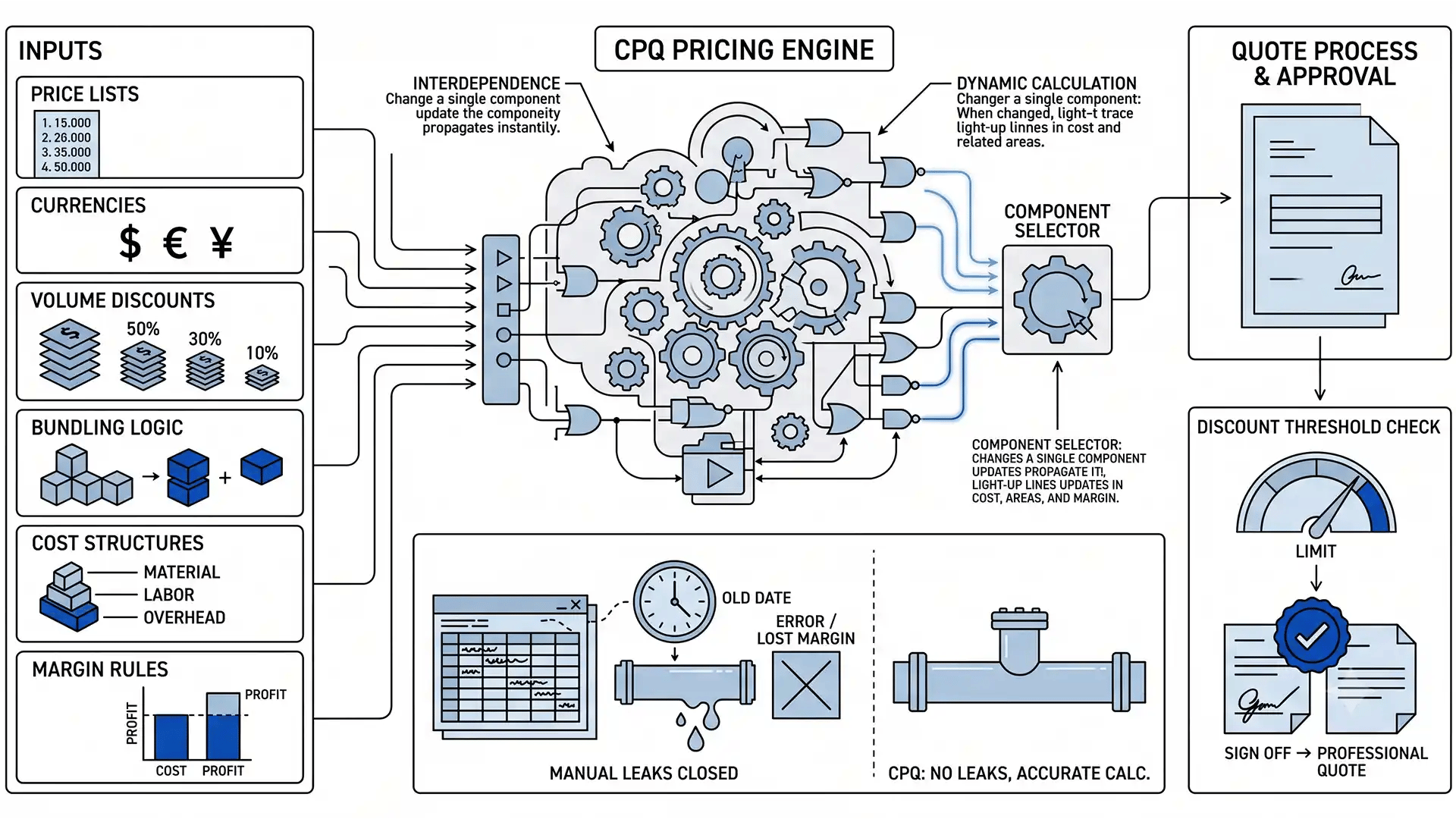
Price means calculating the correct price for the exact configuration — automatically applying price lists, currencies, volume discounts, bundling logic, cost structures, and margin rules. Pricing in CPQ is dynamic: change one component, and every dependent price, discount, and margin updates instantly.
This is where interdependence bites hardest. When products affect each other, so do their prices: a longer contract changes the discount tier, a different component changes the cost base, a service add-on changes the margin picture. Manual pricing of interdependent products is where quotes silently leak margin — a discount applied twice, an outdated cost, a currency conversion from last quarter. CPQ closes those leaks, and approval workflows make sure that when a discount does exceed the threshold, the right person signs off before the customer ever sees it.
What does "Quote" mean in CPQ?
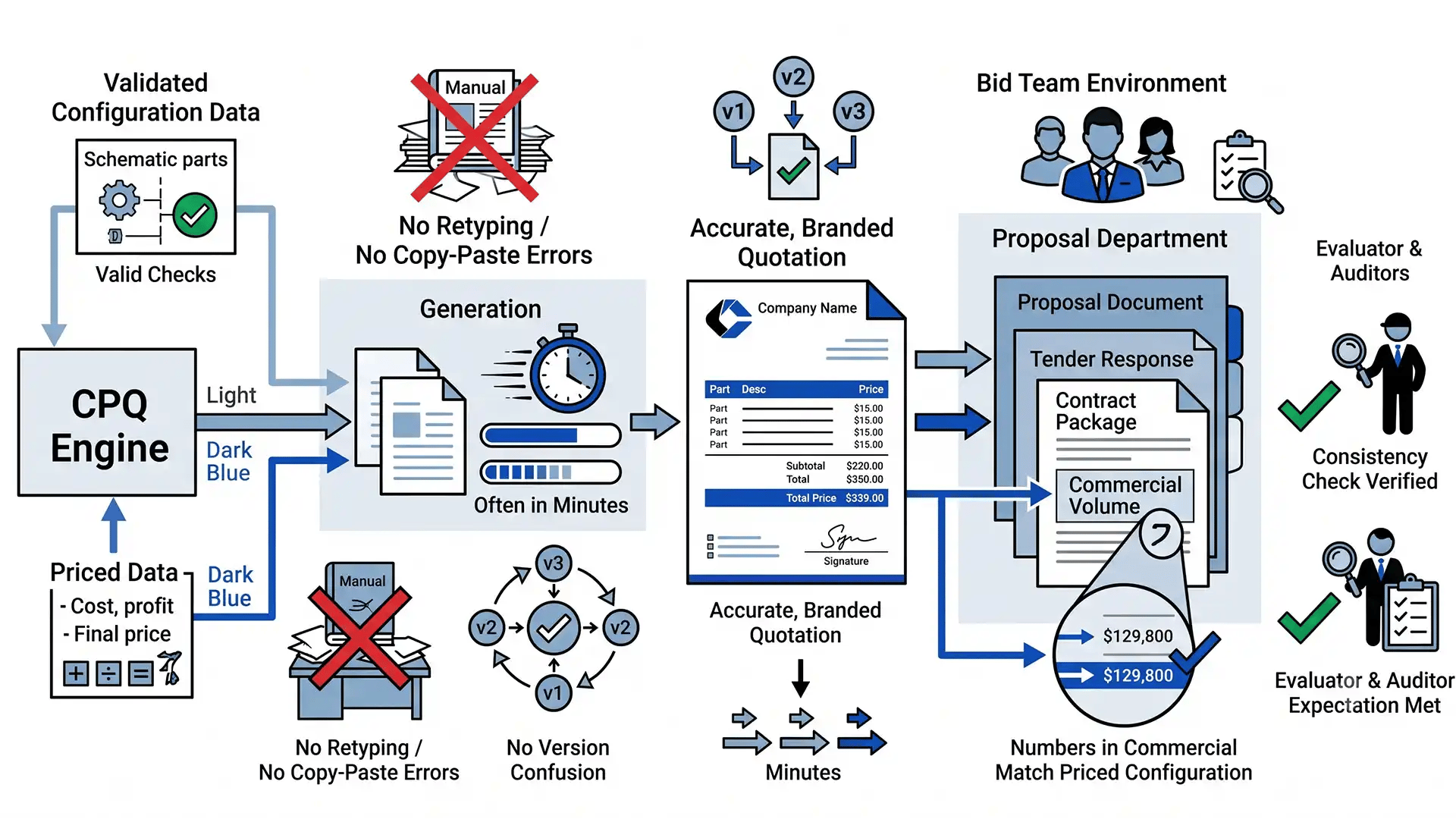
Quote means generating the customer-facing document: an accurate, professional, branded quotation built directly from the validated configuration and pricing — often in minutes. No retyping, no copy-paste errors, no version confusion between what was priced and what was promised.
For bid teams, this step is where CPQ meets your world. The quote rarely travels alone: it lands inside a proposal, a tender response, or a contract package. When CPQ output flows directly into your proposal documents, the numbers in the commercial volume always match the configuration that was actually priced — and that consistency is exactly what evaluators (and auditors) expect.
Why should bid and proposal teams care about CPQ?
Because the quote is part of the bid. A brilliant proposal wrapped around a wrong price still loses — or worse, wins unprofitably. CPQ ensures the commercial core of your bid is accurate, compliant with your own pricing governance, and produced fast enough to leave time for the persuasive work that wins evaluations.
In our guide to [bids, proposals, and tenders], we made the distinction: the bid commits, the proposal convinces. CPQ is the machinery behind the commitment. Three practical payoffs:
-
Speed: Quotes that took days of engineering and finance back-and-forth take minutes — precious time returned to writing and review.
-
Accuracy: Every configuration is buildable and every price is current, so the bid you submit is one you can profitably deliver.
-
Consistency: The same rules apply whether the quote comes from your best sales engineer or the newest hire — quality stops depending on who happens to be available.

What problems does CPQ solve?
CPQ solves five chronic problems: quoting errors from manual data handling, slow turnaround on complex quotes, margin leakage from ungoverned discounting, dependence on a few experts who "know the rules," and inconsistency between what sales quotes and what operations can deliver.
If any of these sound familiar — a quote that promised an impossible configuration, a deal won at a margin nobody approved, a quoting expert whose vacation stalls the pipeline — those aren't people problems. They're process problems, and they're exactly what CPQ was built to fix.
Frequently asked questions about CPQ
What does CPQ stand for? CPQ stands for Configure, Price, Quote — the three steps of producing an accurate quotation for configurable products and services: select a valid combination, calculate the correct price, and generate the customer-facing quote document.
Who uses CPQ software? Sales teams are the primary users, but CPQ serves everyone touched by quoting: bid and proposal teams (accurate commercial content), engineering (valid configurations), finance (pricing governance and margins), and operations (deliverable promises). Industries with complex, interdependent offerings — manufacturing, energy, technology, business services — benefit most.
What is guided selling? Guided selling is a CPQ capability that leads the user through needs-based questions to the right product configuration, instead of requiring them to know the full catalog and every compatibility rule. It lets any salesperson configure like an expert.
Does CPQ integrate with ERP systems like SAP? Yes — and for manufacturers, that integration is often the deciding factor. Product master data, bills of materials, and pricing typically live in the ERP; a CPQ connected to SAP can configure and quote against that live data and hand won orders straight back to production. We'll go deep on SAP integration and variant management in upcoming posts in this series.
What's the difference between CPQ and proposal software? CPQ produces the validated configuration and price; proposal software produces the persuasive document around it. They're complementary: XaitCPQ handles configure-price-quote, while XaitPorter and XaitProposal turn that output into winning bids and proposals. Connected, they ensure the story and the numbers never contradict each other.
Quoting complexity doesn't have to mean quoting chaos. XaitCPQ helps teams quickly and accurately price combinations of interdependent products and services — and feeds those numbers straight into the proposals that win the work.
Next in this series: every Wednesday we're going deeper into product complexity — variant management, configurators, and SAP integration. And in October, the full pricing arc: guided selling, margin protection, and quote-to-contract.
Take the next steps:
Bids vs. Proposals vs. Tenders: What's the Difference and Why It Matters
CPQ Guided Selling: The Key to Faster, Smarter Sales
What Is Variant Management? (coming July 29)