


-1.svg)






Summary
Tender: The client's side of the equation — a formal invitation for suppliers to compete for a contract, along with the process and documents that govern it.
Bid: The supplier's formal offer in response to a tender, traditionally centered on price and the commitment to deliver at that price.
Proposal: The supplier's persuasive case — a document that explains not just what you'll deliver and for how much, but how, why you, and why it matters to the client.
What is the difference between a bid, a proposal, and a tender?
A tender is the client's formal invitation to compete for a contract; a bid is the supplier's offer in response, traditionally focused on price; and a proposal is the persuasive document that presents the supplier's solution, approach, and value. In practice, one pursuit usually involves all three: you respond to a tender by submitting a bid, and the heart of that bid is your proposal.
If you've worked in tendering for a while, you've heard these three words used interchangeably — sometimes in the same meeting, sometimes in the same sentence. Most of the time, everyone still understands each other. But when the terms get blurry, real mistakes follow: teams price a document that was supposed to persuade, or persuade in a document that was supposed to comply.
Think of it like a key, a door, and the reason you're knocking. The tender is the door the client opens. The bid is your key. The proposal is how you convince them to let you in — and not the five other suppliers standing behind you with keys of their own.
Let's take them one at a time.
What is a tender?
A tender is a formal, structured invitation from an organization (the client) for suppliers to submit competitive offers for a specific project, product, or service. The term covers both the process — advertised openly or issued selectively — and the documentation that defines the scope, requirements, deadlines, and evaluation criteria.

The tender belongs to the buyer. It's their rules, their timeline, their scoring sheet. Whether it arrives as an Invitation to Tender (ITT), a Request for Proposal (RFP), or a selective invitation to a pre-qualified shortlist, the tender defines the game you're about to play: what's being bought, how offers will be judged, and what a compliant submission looks like.
That's why understanding the tender process — from needs assessment through evaluation to award — is the foundation for everything that follows. If you haven't already, start with our complete guide to the tender process; this article builds directly on it.
What is a bid?
A bid is a supplier's formal offer to deliver the work described in a tender, at a stated price and under stated terms. Traditionally, "bid" emphasizes the commercial commitment: the price, the schedule, and the legal promise to deliver if selected.

The bid belongs to you, the supplier — and it carries weight. When you bid, you're not just expressing interest; you're making a commitment the client can hold you to. That's why bids demand rigor: cost estimation, risk assessment, resourcing, and a deliberate bid/no-bid decision before a single word gets written.
In everyday usage, "bid" has stretched to mean the entire response package — which is why you'll hear teams talk about "working on the bid" when they mean everything from the pricing volume to the technical narrative. That's fine, as long as everyone remembers what sits at the core: an offer with consequences.
What is a proposal?
A proposal is the persuasive document (or set of documents) in which a supplier presents their solution: the approach, the methodology, the team, the evidence, and the value — not just the price. Proposals answer the client's real question: "Why should we choose you?"
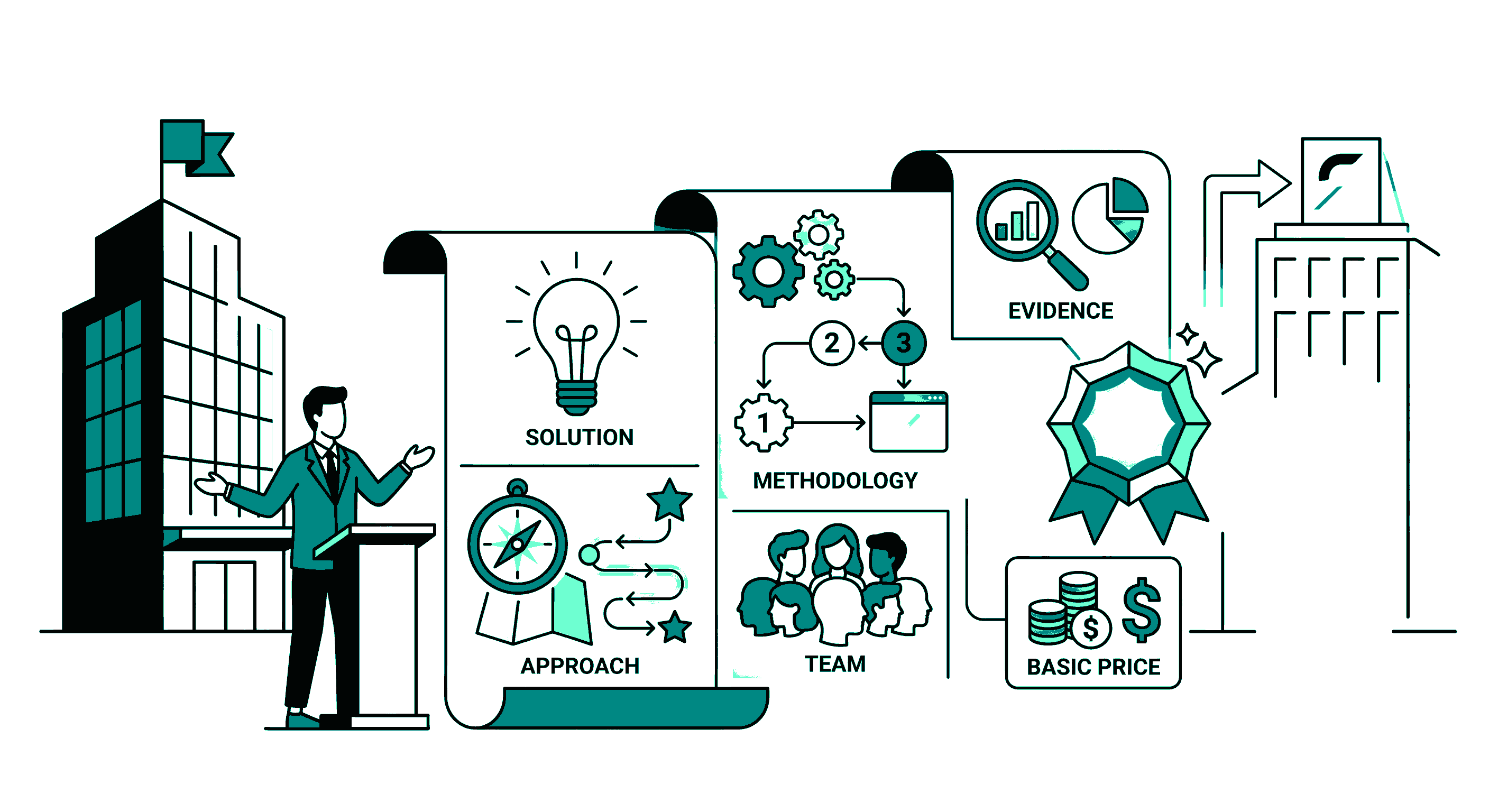
If the bid is the commitment, the proposal is the argument. A strong proposal demonstrates that you understand the client's problem, tailors your solution to their evaluation criteria, and gives evaluators reasons — and evidence — to score you higher than the competition.
This is where deals are won and lost. Two suppliers can offer similar prices and comparable capabilities; the one that communicates value more clearly, more credibly, and more compellingly usually takes the contract. That's a writing discipline in itself, which is exactly where this series is heading in the weeks ahead.
Why does the terminology matter?
Using the terms correctly matters because each word tells your team what kind of document to produce and how it will be judged. Confusing them leads to real losses: a price-only "bid" submitted where a persuasive proposal was expected scores poorly on quality criteria, while an unpriced narrative where a firm bid was required can mean disqualification.
Three practical reasons to get the vocabulary right:
It sets the team's expectations. "We're bidding" and "we're writing a proposal" trigger different work. The first mobilizes estimators, legal, and finance; the second mobilizes writers, subject matter experts, and reviewers. A winning pursuit needs both — deliberately, not by accident.
It reflects how you'll be evaluated. Tenders scored heavily on price reward sharp, compliant bids. Tenders scored on quality, methodology, and experience reward persuasive proposals. Read the evaluation criteria first, and you'll know which muscle to flex where.
It travels differently across regions and sectors. In the UK and much of Europe, "tender" dominates, especially in public procurement. In the US, "proposal" and "RFP response" are the standard vocabulary, and "bid" often signals price-driven, sealed-bid procurement. If your team works internationally — as most of our customers do — a shared vocabulary prevents expensive misunderstandings.
How do bids, proposals, and tenders fit together in one pursuit?
In a typical pursuit, the three connect in sequence: the client issues a tender; you qualify the opportunity and decide to bid; and your submission — the bid — contains your proposal alongside pricing, forms, and compliance documents. The tender defines the rules, the bid makes the offer, and the proposal makes the case.
Mapped against the tender lifecycle it looks like this:
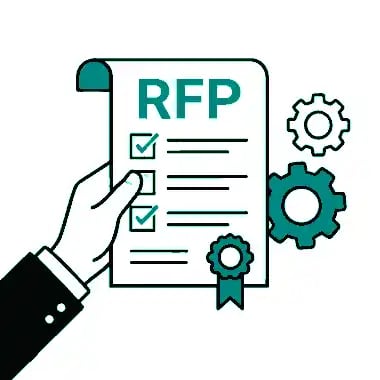 |
The client issues a tender |
|
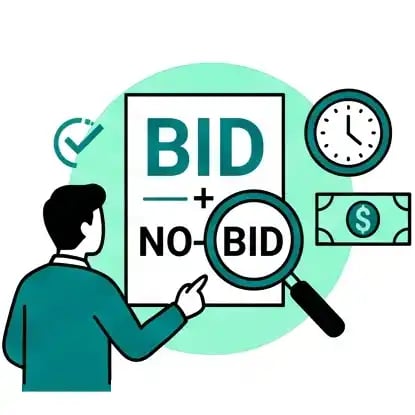 |
You qualify it |
|
 |
You prepare the bid |
|
 |
You write the proposal |
|
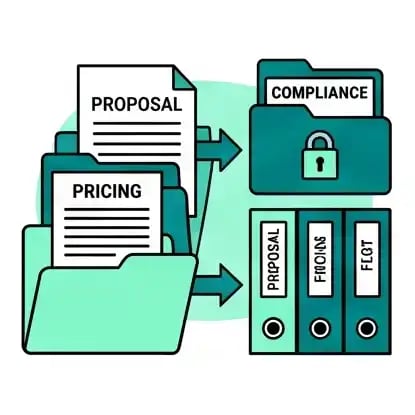 |
You submit the bid |
|
 |
The client evaluates, negotiates, and awards — and your next pursuit begins smarter than the last. |
One pursuit, three terms, each doing a distinct job. Master the distinction, and your team stops producing documents and starts producing wins.
Frequently asked questions
Is a proposal the same as a bid? Not exactly. A bid is the formal offer — price, terms, and the commitment to deliver. A proposal is the persuasive document presenting your solution and value. In practice a proposal is usually part of a bid, and in casual usage the words overlap, but they emphasize different things: the bid commits, the proposal convinces.
Is an RFP a tender? Yes — a Request for Proposal (RFP) is a specialized type of tender. Where a standard tender often focuses on price for a well-defined product or service, an RFP is more open-ended: it asks suppliers to propose how they would solve a problem, and it is evaluated on solution quality and methodology as well as cost.
Which comes first: the tender, the bid, or the proposal? The tender comes first — it's the client's invitation. The supplier then decides whether to bid, and develops the proposal as the core of that bid before submitting the complete package by the tender deadline.
Do the terms mean different things in the UK and the US? The concepts are the same, but usage differs. "Tender" and "ITT" dominate in the UK and Europe, especially in public procurement, while US organizations more often say "RFP" and "proposal." "Bid" is used everywhere, though in the US it often implies price-driven, sealed-bid procurement.
What is a bid in procurement? In procurement, a bid is a supplier's formal, binding offer to provide specified goods or services at a stated price, submitted in response to a tender or solicitation. It typically includes pricing, delivery terms, and the compliance documents the client requires.
Whether your team calls it a bid, a proposal, or a tender response, the challenge is the same: many contributors, complex requirements, and a deadline that doesn't move. That's the problem Xait was built to solve — co-authoring, automation, and a single source of truth for teams that compete for high-value contracts.
Next in this series: how to decide which opportunities deserve your team — the bid/no-bid qualification process. Take the next steps:
The Tender Process: A Complete Guide