


-1.svg)




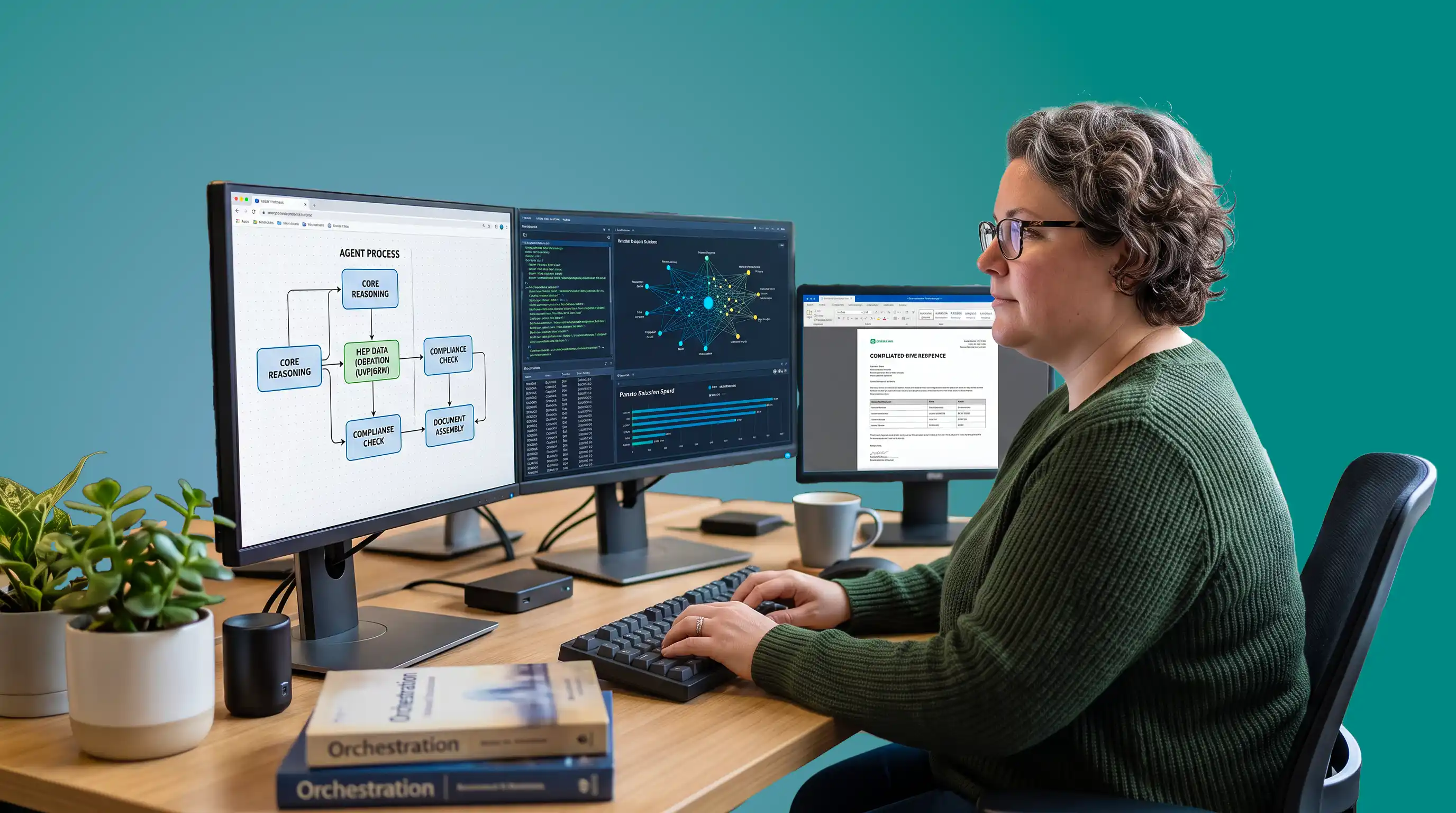
For nearly three decades, Software-as-a-Service (SaaS) operated on a simple premise: build a web application, host it in the cloud, gate it behind a login screen, and sell licenses for human eyes to interact with a user interface (UI). We engineered workflows around human constraints—clicking drop-downs, copying data between browser tabs, and manually orchestrating cross-system tasks.
That model is reaching its systemic limit. The shift from static web software to dynamic AI capabilities is fundamental. As software transforms from passive tools into active participants, the paradigm of "logging into a site" is giving way to background execution, API-first orchestration, and autonomous collaboration.
Driving this shift are autonomous AI agents and the Model Context Protocol (MCP)—an open standard bridging the gap between core intelligence and external infrastructure. This structural change reshapes enterprise software delivery, rendering traditional SaaS UI-centric delivery obsolete while opening the door for a new generation of digital software "coworkers."
1. Defining the Shift: Chatbots vs. Autonomous AI Agents
To understand the transformation under way, we must distinguish between standard language model interfaces and true AI agents.
The Chatbot
A chatbot is primarily conversational and reactive. Built around a text box, it operates on a strict query-and-response loop. You ask a question, it searches its training data or indexed documents, and it returns text. Chatbots lack spatial awareness of your broader ecosystem, have no memory beyond their immediate context window, and, crucially, cannot act. They are digital advisors—they can write a proposal draft, but they cannot query your ERP system, assemble compliance documents, verify pricing matrix logic, and file the bid in a secure repository.
The Autonomous AI Agent
An AI agent is goal-oriented, contextual, and action-capable. Rather than waiting for step-by-step instructions, an agent is assigned an objective (e.g., "Assemble a compliant RFQ response for Client X using our latest Q3 pricing model and enterprise security guidelines").
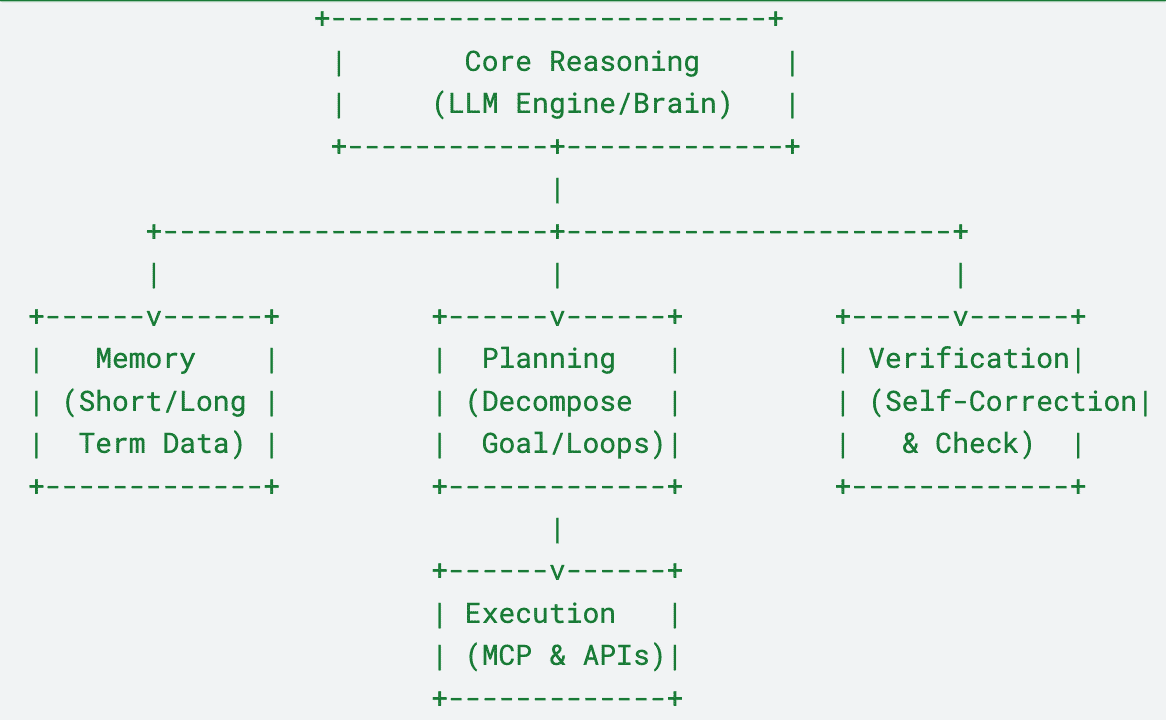
To execute that objective, an agent relies on four core architecture pillars:
-
Core Reasoning (The Brain): Evaluates multi-layered scenarios, breaks ambiguous objectives into logical sub-tasks, and decides which steps to execute.
-
Planning & Self-Correction: Runs internal execution loops. If an initial action fails—such as an API returning a missing field or a data mismatch—the agent adjusts its plan, re-queries, and self-corrects without requiring human intervention.
-
Memory: Manages short-term scratchpad context along with long-term memory across enterprise data vector stores, historical logs, and user preference state models.
-
Execution (Tool Use): Interacts natively with external environments—reading databases, updating CRMs, triggering backend pipelines, and calling webhooks.
An agent does not merely answer questions; it drives multi-step workflows to completion across disparate digital environments.
2. Model Context Protocol (MCP): The Universal Infrastructure Layer
Historically, giving an AI tool access to external business systems meant constructing brittle custom integrations. If an enterprise used 10 software tools and wanted to connect them to 5 different AI models, developers had to manage an $N \times M$ integration matrix. Every endpoint update risked breaking the pipeline.
Introduced by Anthropic as an open standard, the Model Context Protocol (MCP) functions as a universal connective layer for AI integrations—often referred to as the "USB-C port for AI application states".
How MCP Architecture Works
MCP standardizes how an AI system (the MCP Client) connects to external data repositories and operational capabilities (the MCP Server).
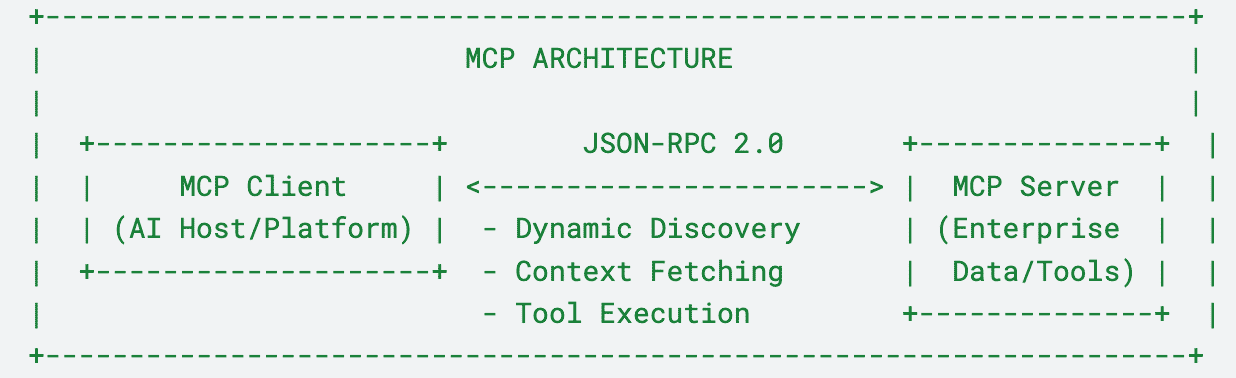
Built on lightweight JSON-RPC 2.0, MCP exposes three foundational capabilities:
- Resources: Read-only data streams (e.g., database records, live application logs, active document repositories) that feed fresh context to the model.
- Prompts: Pre-configured template directives and contextual workflows designed for specific tasks.
- Tools: Executable functional actions that the agent can trigger dynamically (e.g., executing a calculation script, generating a proposal template, running security validation checks).
The End of GUI-First Integration
MCP decouples the AI reasoning engine from the underlying software interface. Historically, software vendors provided value by offering a visual user interface sitting on top of a database.
With MCP, software capabilities are directly exposed as structured tools and resources to autonomous agents. The agent handles command discovery, parameters, execution, and verification behind the scenes.
Users no longer need to navigate to app.vendor.com, navigate five nested tabs, click "Export to PDF," and re-upload the file elsewhere. Instead, an agent running locally or within an enterprise environment queries the app's MCP server directly, pulls the precise payload, and moves forward with execution.
3. The Impact on Traditional SaaS: From Platforms to Invisible Infrastructure
This structural migration directly impacts incumbent SaaS providers. When software consumption transitions from human end-users to autonomous agents, the core economics, metrics, and design patterns of SaaS shift.
|
Dimension |
Traditional SaaS (2010–2024) |
Agent-Native Software Architecture |
|
Primary User |
Human worker manipulating a GUI |
Autonomous Agent using MCP / APIs |
|
Value Metric |
Time-in-app, user engagement |
Task completion velocity, background accuracy |
|
Monetization |
Per-Seat Monthly Subscription ($/user/mo) |
Consumption, Credit, or Outcome-Based Pricing |
|
Defensibility |
UI design, workflow habit lock-in |
Data velocity, deep system integrations, security compliance |
|
Integration |
Custom REST APIs, Webhooks, iPaaS |
Dynamic MCP Discovery, Context Standardizations |
The Death of the "Per-Seat" Model
The classic enterprise SaaS pricing mechanism collapses when work is handled by AI agents.
If an autonomous agent performs the document-processing workload previously handled by ten team members, charging for a single user seat destroys the software vendor's revenue trajectory. Conversely, charging for 10 empty human seats creates buyer friction.
As a result, SaaS monetization is moving toward:
- Outcome-Based Pricing: Monetizing validated, completed outputs (e.g., dollars per verified proposal generated, ticket resolved, or code branch merged).
- Compute/Token Credits: Charging for the operational workload, context windows used, and system executions driven by background agents.
The Disintermediation of the Graphical User Interface (GUI)
When software interfaces are consumed primarily by software agents, traditional front-end investment loses its status as a primary moat. A sleek dashboard yields lower leverage if human workers spend less time looking at it.
Value moves from surface UI to deep operational capabilities:
- Security enforcement and compliance guardrails
- Authoritative database repositories and proprietary domain knowledge
- High-speed execution protocols
- State-management and transactional reliability
SaaS vendors that fail to provide robust API and MCP server endpoints risk being relegated to background utility layers, stripped of their direct relationship with the end user.
4. The "Coworker" Operating Model
Industry leaders like Anthropic and OpenAI describe the evolution of workplace software as shifting from point solutions to digital coworkers.
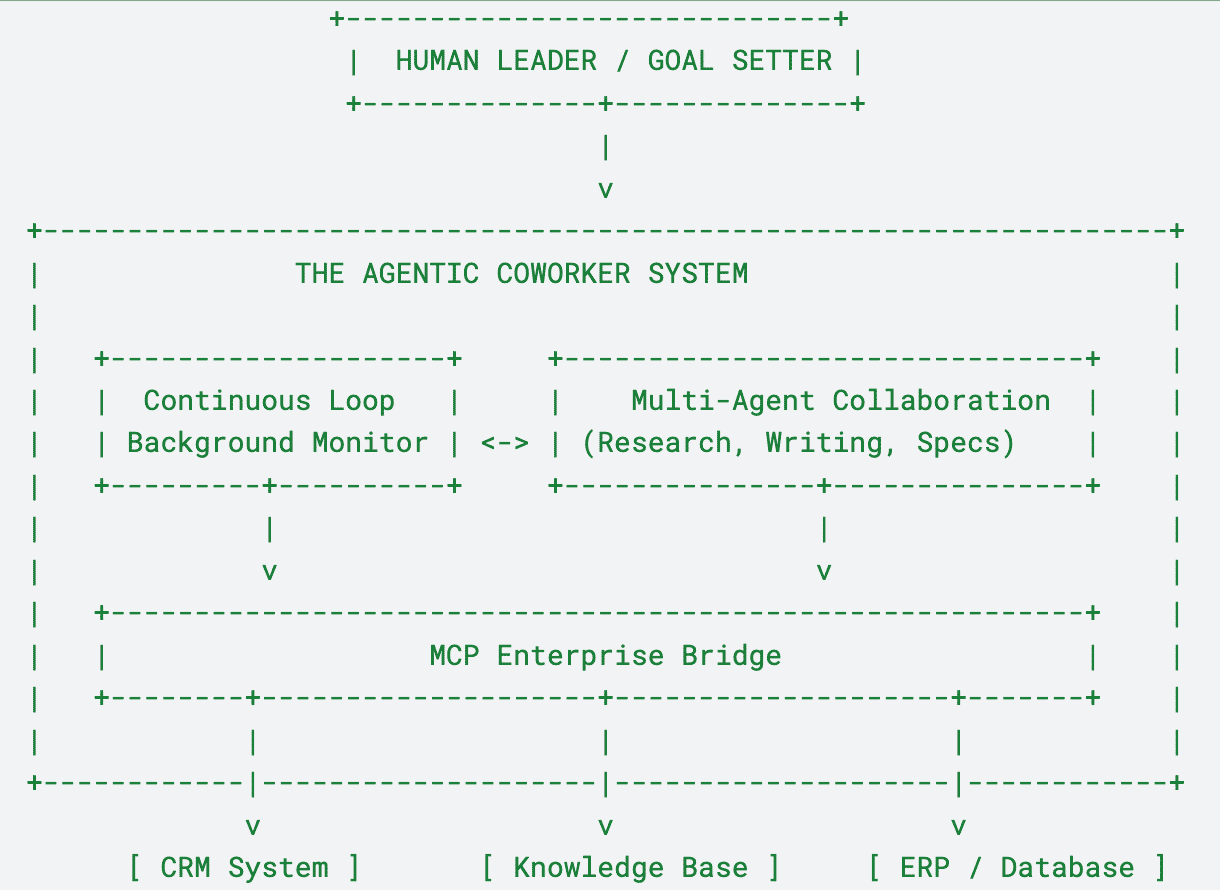
A digital coworker operates as an autonomous entity embedded directly within operational channels.
Key Characteristics of the Coworker Model
- Proactive Persistence: Traditional tools wait to be clicked. A digital coworker continuously monitors data streams, detects events (such as a newly posted Request for Proposal or a changing compliance standard), and initiates workflows independently.
- Multi-Agent Orchestration: Complex operations rarely rely on a single monolithic model. Specialized sub-agents collaborate seamlessly—one handling technical specs, another cross-referencing legal requirements, and a third validating budget constraints.
- Asynchronous Contextual Integration: Coworkers operate quietly in the background, surfacing to human team members only when high-level strategic alignment, creative review, or formal approval is required.
In this paradigm, human professionals move from software operators to delegators and managers of agent fleets.
5. Opportunity for Document & Proposal Software: Bringing Proposal Coworkers to Enterprise SaaS
Nowhere is the shift toward digital coworkers more impactful than in enterprise sales, tender management, and RFP response workflows. Complex proposal creation is historically resource-intensive, requiring manual data collection across sales engines, technical engineering specs, compliance databases, and executive sign-offs.
In a traditional setup, human proposal teams spend dozens of hours navigating separate SaaS portals—pulling pricing matrices from an ERP, pulling case studies from a CMS, running compliance checks in spreadsheets, and manually formatting documents in word processors.
The integration of autonomous agents and MCP shifts this model entirely.
The Enterprise Proposal Coworker
Rather than serving as a static document repository where humans log in to manually construct responses, advanced platforms like Xait are uniquely positioned to transform proposal management into an active agentic ecosystem.
By deploying an enterprise-grade Proposal Coworker, the platform moves beyond document creation to end-to-end workflow execution:
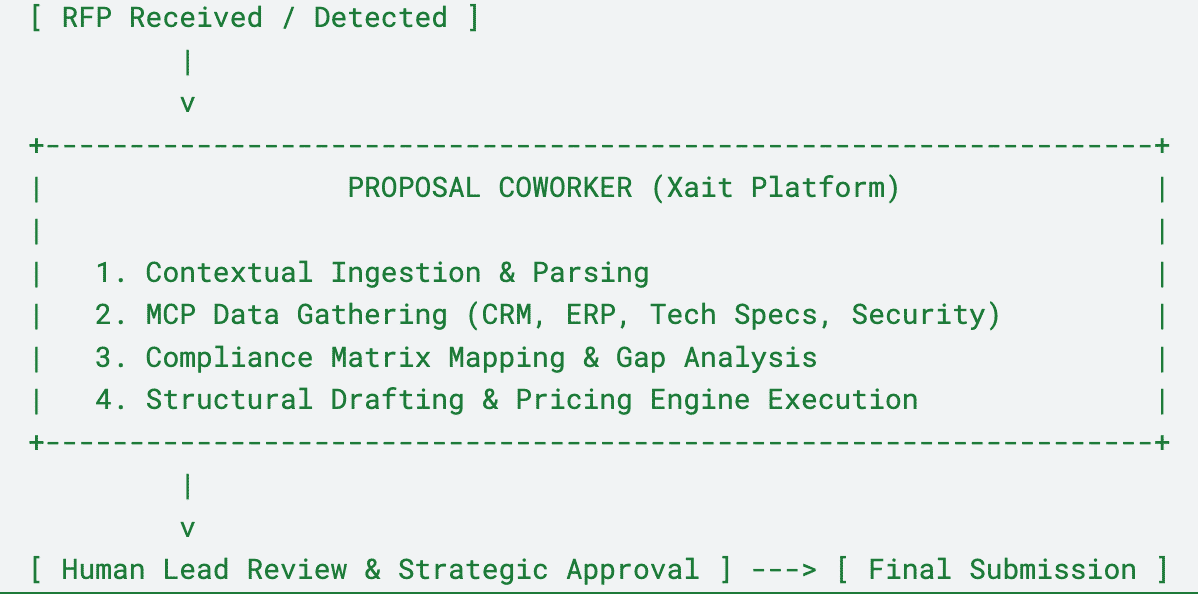
- Autonomous Context Gathering via MCP: Upon receiving an incoming RFP, the Proposal Coworker connects directly to corporate systems via MCP servers. It pulls verified pricing models, current technical configurations, legal clauses, and case studies automatically—eliminating manual context switching.
- Dynamic Gap Identification: The agent cross-references the tender requirements against internal knowledge repositories, identifies missing compliance documentation, flags potential risks, and assigns targeted sub-tasks to human subject matter experts.
- Structured Document Assembly: Leveraging native enterprise content controls, the agent builds a fully structured, brand-compliant bid draft adhering to strict security and governance rules.
- Continuous Collaboration: The Proposal Coworker works alongside human capture managers asynchronously. It suggests winning deal strategies based on historic win/loss data while leaving final strategic control in human hands.
Embracing the Future of Agent-Driven SaaS
The transition from passive software interfaces to autonomous digital coworkers is an architectural shift. As MCP becomes the universal standard connecting models to enterprise infrastructure, SaaS applications must evolve from places where work is manually performed into intelligence engines that perform work autonomously.
For organizations navigating complex bid creation and document collaboration, this shift presents a clear competitive advantage. By introducing proposal coworkers into the enterprise software stack, platforms like Xait are redefining how complex work gets done—freeing teams from low-leverage administrative tasks and allowing them to focus on strategy, innovation, and closing high-value deals.